Total across the five placement awards.
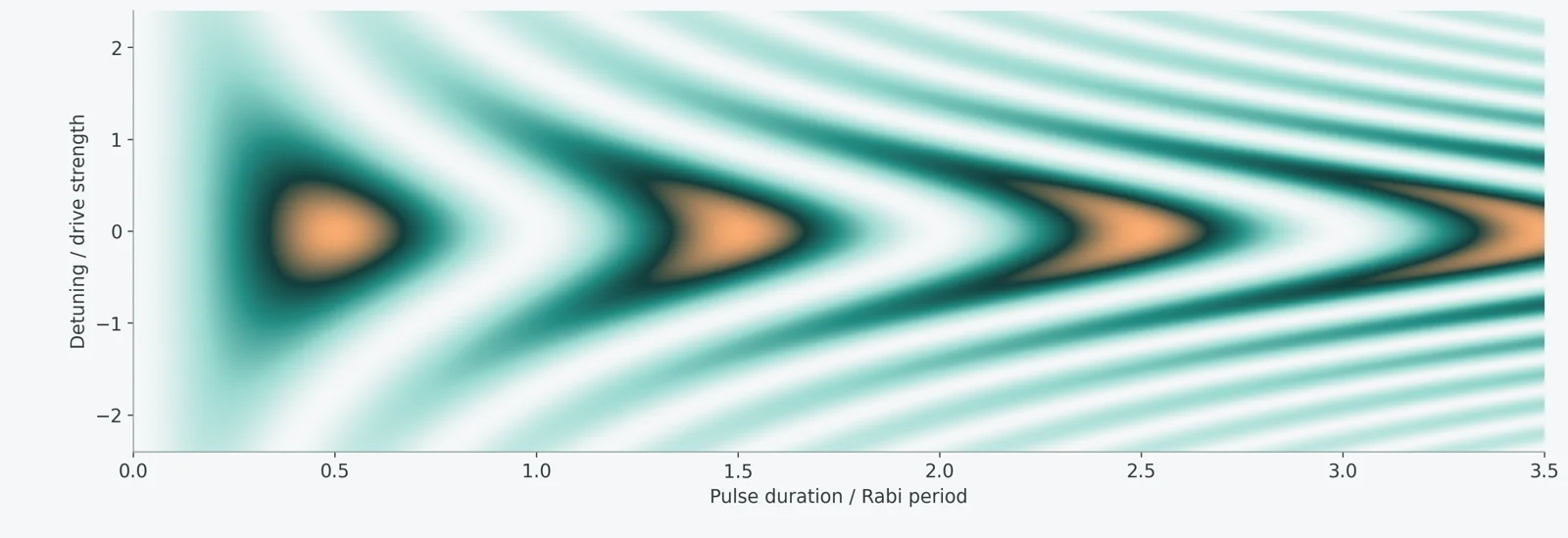
RABI OSCILLATIONS
Pulse duration × detuning · ideal two-level modelIllustration, not experimental data
Agentic Quantum Coding Challenge
An online challenge to build AI agents for quantum engineering.Design your harness around Hunyuan 4 Preview and put it to the test.
Can your harness beat GPT-6 Astra?
Only the strict first team to exceed GPT-6 Astra on the hidden leaderboard.
If nobody exceeds it, the award is not paid.
TIMELINE Date progress
UTC+8
- Competition begins
- Submission deadline
- Demo Day
Task
Every team uses the same Tencent Hunyuan 4 Preview (HY4) model.
Your goal is to improve the harness around it: how the agent plans experiments, uses tools, learns from evidence and produces reliable solutions to quantum engineering tasks.
What your agent must do
QIQCBench presents engineering problems in Quantum-Harbor, a simulated quantum laboratory. Your agent reads the task, chooses experiments within its resource budget, interprets the measurements and submits an answer that a separate verifier can check.
- Characterize a system.
Estimate an unknown Hamiltonian or predict quantum correlations. - Calibrate an experiment.
Tune a controlled-Z pulse or a logical-CNOT decoder. - Design measurements.
Estimate molecular energy and its uncertainty.
5 public practice tasks44 hidden evaluation tasks
Explore a task, step by step.
Understand the objective.
Read the task instructions and device specifications. Identify the quantity to estimate or the operation to calibrate, the available tools and the limits on experiments.
Start with a clear target and an experiment budget.
Build
Docker, uv, git and Python 3.11+. On Windows, use Linux containers through WSL2. The no-key check below tests the public environment.
uv tool install 'harbor==0.18.0'
git clone https://github.com/GaugeForge/Quantum-Harbor
cd Quantum-Harbor
git checkout 1f03d78e959cf02469568250f61f9af88a53146f
uv sync
docker build -t qiqcbench-agent docker/agent/
uv run python tools/build_qsim_images.py --tasks time_budgeted_hamlearn_10q
harbor run -p harbor_tasks/time_budgeted_hamlearn_10q -a nop
harbor view jobs
Expected result: reward 0. The nop agent performs no science. This is an installation check, not an official entry.
The public repository includes example agent configurations. The competition Hunyuan 4 Preview adapter, exact model ID and upload service are to be announced. The current examples must not be presented as a working event integration.
Partners
Hosted by GaugeForge. Community distribution, expert review, model support and post-event experiments are available ways to contribute.
External partners will be announced after confirmation. No external organization is currently listed as a confirmed event partner.
FAQ
Who can enter?
Individuals and teams of up to three people. There is no academic or professional qualification requirement. Applicable law and valid consent still apply.
What exactly am I building?
An agent harness: the code that plans work, invokes tools, manages experiment state and verifies results around a fixed Hunyuan 4 Preview (HY4) model. You may modify an existing harness or build your own.
Is registration open?
Yes. Use the registration form to join the challenge.
Are model credits unlimited?
The event model is Tencent Hunyuan 4 Preview (HY4). Exact API quota and development allowance are to be announced. Each team has at most three official full benchmark evaluations.
How is the Challenger Award different?
USD 15,000 goes only to the strict first qualifying Hunyuan 4 Preview (HY4) team to exceed the GPT-6 Astra baseline on the hidden leaderboard. If no team exceeds it, the award is not paid. Timestamp, baseline and stacking details will be frozen before registration.
Are hidden tasks guaranteed uncontaminated?
No. Public paper tasks and repository material are already accessible. Hidden means withheld during evaluation, not proven absent from training data. Evaluation uses recorded evidence and controlled conditions.
Do I need quantum hardware?
No. Quantum-Harbor provides a simulated laboratory. Real-hardware access is not part of the announced competition.
What must I open source?
Submitted harness code is required to be AGPL open source. The exact version and release timing will be frozen before registration. Data and trajectory use has separate terms, including named organizer and partner recipients.
Where are submissions uploaded?
The event submission interface is not yet released. The public repository supports local task runs. The participant guide labels the proposed competition package separately.
More questions? Email us.
shenhao.miao@gauge-forge.comEmail inquiry only. Your mail application opens; nothing is sent automatically.